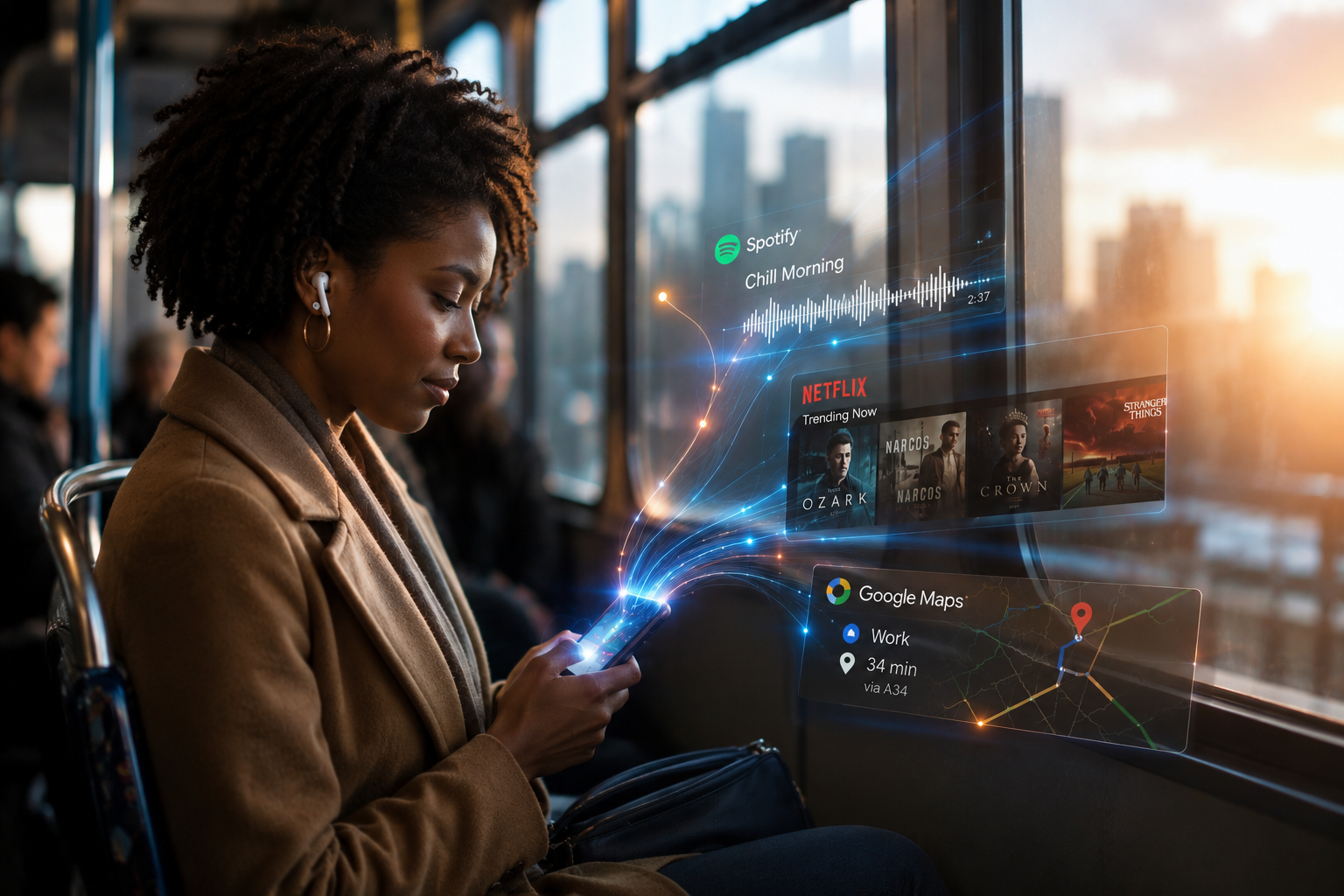
You opened Spotify this morning. A playlist appeared, perfectly matched to your mood, your commute, your vibe. You didn’t search for it. It just knew.
Then you opened Google Maps. It told you to leave ten minutes earlier than usual, rerouting you around a jam that hadn’t even fully formed yet. You trusted it. You always do.
Later, you sat down to watch Netflix. Before you could think of what to watch, three thumbnails stared back at you, all things you’d probably love. You picked one. Of course you did.
Here’s the thing nobody tells you: none of that was magic. It wasn’t a team of people manually curating your experience. It was machine learning, algorithms quietly watching, learning, and predicting you, millions of times a second.
Let’s break down exactly how.
Spotify: The App That Listens More Than You Do
When Spotify recommends a song, it’s not guessing. It’s doing three things simultaneously.
First, it’s watching you. Every skip, every replay, every time you let a track play all the way through, that’s data. Spotify tracks all of it to build a model of your taste that’s unique to you.
Second, it’s listening to the music itself. Spotify analyses the raw audio of every track, the tempo, the energy, the danceability, how acoustic or electronic it sounds. This is why it can recommend a song you’ve never heard from an artist you don’t follow, and somehow it fits perfectly. It’s not matching artists, it’s matching sound.
Third, it’s reading the internet. Spotify’s AI crawls blogs, reviews, and music commentary across the web to understand how people talk about artists and tracks. If thousands of writers describe two artists with the same words, the algorithm takes note and links them together.
All three signals are combined through a technique called collaborative filtering, essentially, finding listeners whose tastes overlap with yours and asking: what else did they love?
The result? Discover Weekly. Your Daily Mix. Wrapped. A system so personalised that Spotify processes over half a trillion events every single day to keep it running.
Netflix: Why the Thumbnail You See Isn’t the One I See
Here’s something most people don’t know: when Netflix shows you a film, the thumbnail image you see is likely different from the one your friend sees.
Netflix uses machine learning to test which images make you most likely to click. If you tend to watch films because of a particular actor, it’ll show you a thumbnail featuring that actor prominently. If you respond to dramatic scenes, it’ll pick that frame instead. The algorithm has run so many of these tests that it now knows your visual preferences almost better than you do.
But that’s just the surface.
Netflix’s recommendation engine accounts for over 80% of everything people watch on the platform. The AI behind it looks at your watching history, how long you linger on a title before clicking away, whether you binge or dip in and out, and what people with similar habits to yours have loved. The system also considers time of day, you probably don’t want a complex thriller at 11pm on a Tuesday.
Netflix estimates that this recommendation system saves the company around $1 billion a year in subscriber retention. When the algorithm keeps you watching, you don’t cancel.
Google Maps: Predicting Traffic That Hasn’t Happened Yet
This one might be the most impressive of the three.
When Google Maps gives you an ETA, it’s not simply measuring how far away your destination is. It’s predicting the future, what traffic will look like not just now, but in 20, 30, even 50 minutes’ time, by the time you actually reach those roads.
To do this, Google partnered with DeepMind (Alphabet’s world-class AI lab) to build something called Graph Neural Networks. Think of the entire road network as a web of connected points. The AI understands how traffic flows across that web, not road by road, but as an interconnected system. A slowdown in one place ripples outward, and the model predicts exactly how.
The results are striking. Google Maps ETA predictions are now accurate on over 97% of trips. In cities like Berlin, Jakarta, São Paulo, and Washington D.C., the partnership with DeepMind cut remaining errors by up to 50%.
And in 2026, Google took things further, integrating Gemini AI into Maps with a feature called Ask Maps, letting you ask questions like “where can I get a quiet coffee near here before my meeting?” and get back an actual, personalised answer. It’s pulling from over 300 million places and community reviews to do it.
Your commute is a machine learning problem. Google is just solving it quietly, every day, in the background.
So What’s Actually Happening Under the Hood?
All three of these apps, different industries, different products, are running on the same fundamental idea:
The more you use them, the smarter they get about you.
Every interaction is a data point. Every data point feeds a model. Every model gets refined. And over time, the experience becomes so personalised that it starts to feel less like technology and more like intuition.
That feedback loop, use, learn, improve, repeat, is the engine behind modern machine learning at scale. It’s not magic. It’s mathematics, applied to billions of people, billions of times a day.
The Question Worth Asking
The next time Spotify plays the perfect song, or Netflix surfaces a show you didn’t know you needed, or Google Maps saves you from a traffic jam you never saw, pause for a second.
Ask yourself: how much of my behaviour am I actually choosing, and how much is being shaped by a system that knows me better than I realise?
That’s not a reason to be afraid. It’s a reason to be curious.
Because understanding how these systems work is the first step to using them, rather than being used by them.
Machine Learning, AI, Agentic AI
The AI That Runs Your Life (And You Never Even Noticed)
In this article
You opened Spotify this morning. A playlist appeared, perfectly matched to your mood, your commute, your vibe. You didn’t search for it. It just knew.